
Inclusive PE: How Technology Can Help Every Child Take Part
Creating more accessible, engaging and enjoyable PE experiences for every pupil
PE should be one of the most inclusive parts of the school day.
It gives children the opportunity to move, play, develop confidence, build social skills and experience the enjoyment of being active.
But for some pupils, particularly children with physical, sensory, communication or additional needs, participating in a traditional PE lesson can present significant challenges.
So, how can schools make PE more inclusive?
And could technology provide teachers with another practical tool to help more children participate?
A new initiative from ParalympicsGB and NatWest Thrive is putting this question firmly in the spotlight with the launch of Equal Play in PE, a programme designed to support teachers in delivering more inclusive PE during the 2026–27 academic year.
What is inclusive PE?
Inclusive PE is about creating opportunities for every pupil to participate in physical education, regardless of their ability, disability or individual needs.
That doesn't necessarily mean every child doing exactly the same activity in exactly the same way.
Instead, inclusive PE recognises that pupils may need different approaches, adaptations, equipment or levels of challenge to participate successfully.
The aim is to create PE lessons where children can:
- Participate in physical activity
- Develop movement and coordination skills
- Build confidence
- Interact with their peers
- Experience achievement
- Have fun
- Feel that they belong
And that final point is particularly important.
The growing challenge around SEND and PE
Research published by ParalympicsGB and NatWest Thrive surveyed more than 150 teachers across UK primary and secondary schools to understand some of the challenges surrounding inclusive PE.
The findings highlight a significant gap between understanding the importance of inclusion and having the practical confidence and resources to deliver it.
95% of teachers surveyed encounter physical or sensory needs in their lessons.
Yet only 45% feel confident supporting physical needs, while fewer than one in ten feel very confident delivering parasports.
There is also a clear knowing-doing gap.
While 89% of teachers understand inclusion in principle, only 44% find SEND guidance easy to apply to an actual PE lesson.
This is an important distinction.
Knowing that PE should be inclusive is one thing.
Knowing exactly how to adapt an activity for a particular pupil, in the middle of a busy PE lesson, is another.
Inclusive PE is about more than participation
One of the most striking findings from the ParalympicsGB research is that 97% of teachers said inclusive PE is about belonging, confidence and enjoyment.
In fact, 57% ranked belonging as the most important outcome, ahead of participation and skill development.
That changes the way we think about inclusive PE.
It's not simply about finding a way for a pupil to be present in a PE lesson.
It's about creating an experience where they can take part, interact, achieve, have fun and feel part of the group.
Sometimes that means adapting the rules.
Sometimes it means changing the equipment.
Sometimes it means changing the environment.
And sometimes, technology can provide another way for children to interact with movement.
How can technology support inclusive PE?
Technology isn't a replacement for teachers, PE specialists or effective inclusive teaching.
But inclusive PE technology can provide teachers with another practical tool for creating different ways to participate.
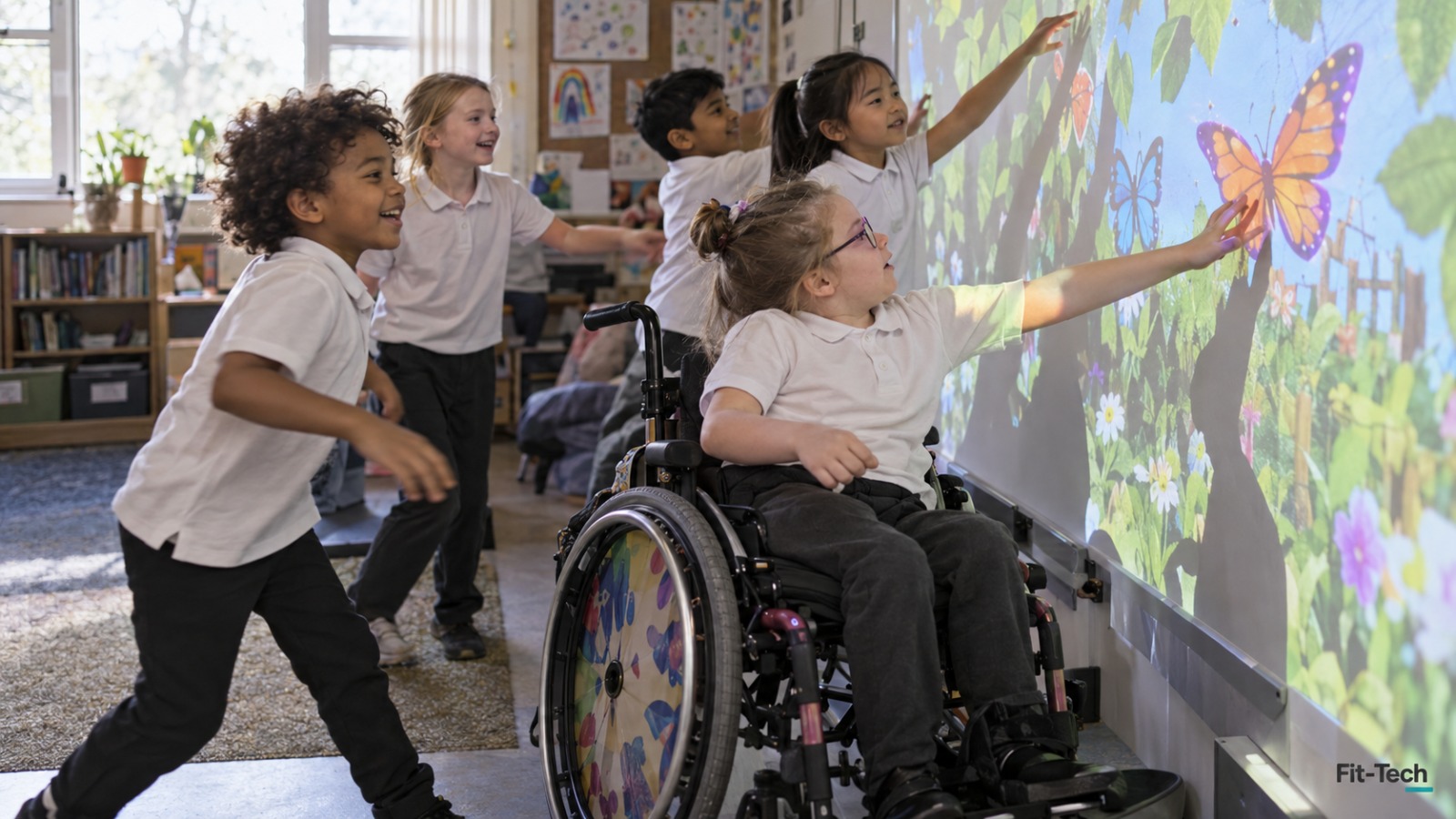
Interactive floors and walls are one example.
Rather than relying solely on traditional sporting activities, interactive technology can turn movement into a visual, responsive and engaging experience.
A pupil might be asked to:
- Reach for a target
- Step on a particular colour
- Follow a visual pathway
- React to moving objects
- Work with another pupil
- Complete a movement challenge
- Improve their reaction time
- Move around a projected environment
The important thing is that the activity can become the challenge, rather than the child's physical ability being the barrier to participation.
Interactive PE can make movement feel like play
For some pupils, traditional PE can feel intimidating.
They may struggle with competitive sports, find certain movements difficult or simply not enjoy activities where their ability is constantly being compared with others.
Interactive technology can offer a different experience.
Instead of saying:
“Can you play this sport?”
the activity might ask:
“Can you catch the target?”
“Can you reach the light?”
“Can you beat your previous score?”
“Can you work with your partner?”
That subtle change can create a very different experience.
The focus becomes movement, interaction and achievement.
And that's something that can be adapted for a wide range of abilities.
Supporting SEND pupils through technology
Interactive technology can be particularly interesting for SEND schools and mainstream schools with SEND provision.
Visual feedback can provide an immediate response to movement, while interactive activities can be adapted to different levels of challenge.
Depending on the system and activity, technology can be used to support areas such as:
- Gross motor movement
- Coordination
- Reaction speed
- Balance
- Spatial awareness
- Attention
- Following instructions
- Turn-taking
- Social interaction
- Confidence and engagement
It can also provide teachers with opportunities to create activities that don't necessarily rely on conventional sporting skills.
That can help broaden the definition of what successful participation in PE looks like.
PE technology for schools shouldn't replace good teaching
It's important to make one thing clear.
Technology isn't the solution to inclusive PE on its own.
The ParalympicsGB research highlights the importance of practical guidance and teacher confidence. Its new Equal Play in PE programme aims to provide teachers with resources that are needs-based, activity-specific, practical and realistic for use in real-world PE lessons.
Technology should work alongside that approach.
The teacher remains at the centre of the lesson.
Technology simply gives them another tool.
The best solutions are those that are easy to use, flexible enough to accommodate different pupils and capable of supporting meaningful activity rather than simply looking impressive.
Where can inclusive PE technology be used?
Inclusive technology doesn't have to be restricted to a traditional sports hall.
Depending on the equipment, interactive activity technology can be used across a variety of environments.
Mainstream schools
Interactive activities can add variety to PE and provide alternative ways for pupils to develop movement, coordination and reaction skills.
SEND schools
Technology can provide highly visual and interactive experiences that can be adapted to different abilities and levels of engagement.
Intervention and therapy
Movement-based interactive activities can also complement programmes focusing on coordination, motor skills, attention and engagement.
Clubs and enrichment
Interactive technology can create additional opportunities for physical activity during clubs, enrichment sessions, break times and other parts of the school day.
Creating a more inclusive PE environment
At Fit-Tech, we believe technology should always have a purpose.
We're not interested in schools buying technology simply because it looks impressive.
We're interested in what it can help pupils and teachers achieve.
That's why we work with schools, SEND settings and education professionals to explore how interactive floors, interactive walls and other activity technologies can complement existing PE and physical activity provision.
For some schools, that might mean creating a more engaging PE lesson.
For others, it might mean providing additional opportunities for pupils who struggle with traditional sports.
And for SEND settings, it could provide another environment where movement, interaction and achievement can be explored at an individual's own level.
Every child deserves the opportunity to take part
The launch of Equal Play in PE is an important reminder of the work still needed to make PE genuinely inclusive.
ParalympicsGB's wider Equal Play campaign highlights that only one in four disabled children regularly take part in PE and school sport, and calls for greater access to inclusive PE and school sport.
There is no single solution.
Teachers need practical support.
Schools need appropriate resources.
Pupils need opportunities to participate in ways that work for them.
And technology can potentially form part of that picture.
When carefully selected and used alongside good teaching, inclusive PE technology can provide another way for children to move, play, interact and achieve.
Because PE shouldn't be about who can do the most.
It should be about giving every child an opportunity to take part.
How Fit-Tech can help
At Fit-Tech, we supply a growing range of interactive floors, interactive walls and activity technology for schools and SEND settings across the UK.
If you're looking at your school's PE provision, SEND provision or wider physical activity offer, we'd be happy to show you what's possible.
Want to explore inclusive technology for your school?
Get in touch with the Fit-Tech team to arrange a conversation or demonstration.
Fit-Tech
📧 hello@fitness-tech.co.uk
🌐 fitness-tech.co.uk